
Prussian White Cathode Material

  • Home
  • Prussian White Cathode Material
section 1

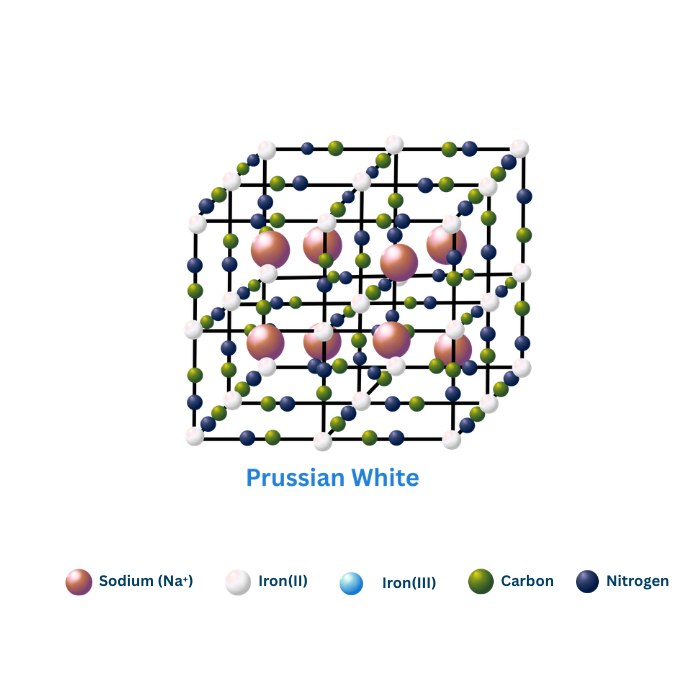
Prussian White (Na₂Fe[Fe(CN)₆]) is a high-performance sodium iron hexacyanoferrate cathode material developed for next-generation sodium-ion batteries (SIBs). It is a sodiated form of Prussian Blue Analogues (PBAs), featuring a porous framework with octahedrally coordinated transition metal centers linked by cyanide bridges. It contains disordered and dynamic water molecules that exhibit a dualistic effect on battery performance, influencing both sodium-ion transport and structural stability.

Due to its rigid open-framework cubic crystal structure and the rapid intercalation and extraction of sodium ions with minimal lattice strain during charge-discharge cycling, Prussian White is emerging as a promising cathode material for next-generation Battery Energy Storage Systems (BESS). Its excellent rate capability, long cycle life, and cost-effective composition make it highly suitable for large-scale grid storage, industrial battery applications, and electric mobility systems.
Properties

Physical & chemical Properties

Product NamePrussian White Powder
CAS No897920-00-2
IUPAC NameSodium Iron Hexacyanoferrate
SynonymsBerlin White, Everett’s Salt, PW, Prussian White Analogue, PBAs
Elemental CompositionNa 14.33%, Fe 36.83%, C 22.03%, N 23.83%
Molecular FormulaNa₂Fe[Fe(CN)₆]
Molecular Weight314 g/mol
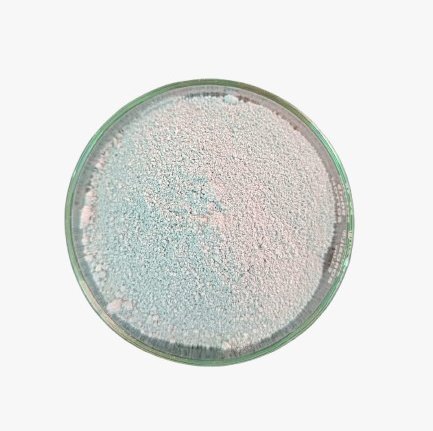
AppearanceWhite Colour Powder
pH7.3
Density0.6 g/cm³
Particle Size DistributionD10: 2.812 μm
D50: 4.502 μm
D90: 6.767 μm
D100: 9.43 μm
StorageStored at Room Temperature, Should be used in Inert Atmosphere
WhatsApp Image 2026-07-10 at 12.28.02 PM
Electrochemical properties
StructureOpen 3D Framework Enables Facile Na⁺ Intercalation
Theoretical Capacity~155–170 mAh/g
Specific Capacity>150 mAh/g over 1000 cycles (on par with LFP)
Coulombic Efficiency~99.9%
Operating Voltage2.2–4.0 V 
Average Discharge Voltage≈2.5–3.6 V
Intercalation PropertiesFast, reversible Na⁺ insertion/extraction through large interstitial sites
Volumetric StabilityExcellent dimensional stability during cycling
Cycle Life≥90% capacity retention Over thousand cycles
Key AdvantagesLow cost, high safety, fast Na⁺ diffusion, aqueous scalable synthesis
USPs of Macsen’s Prussian White

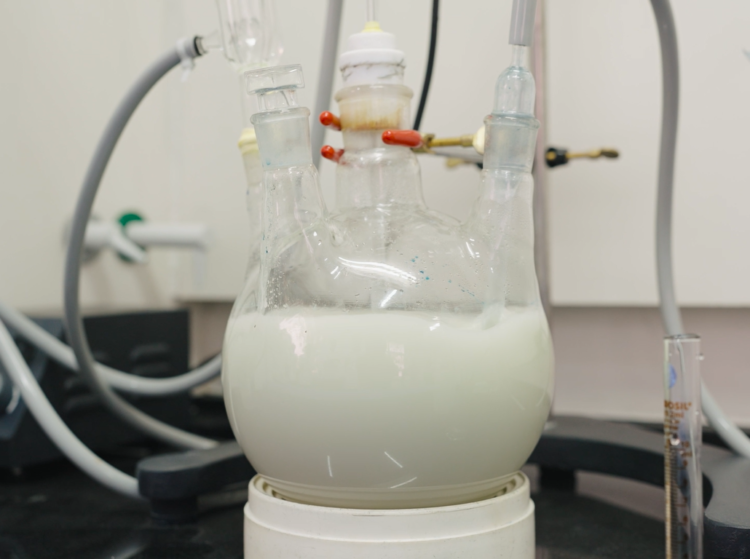
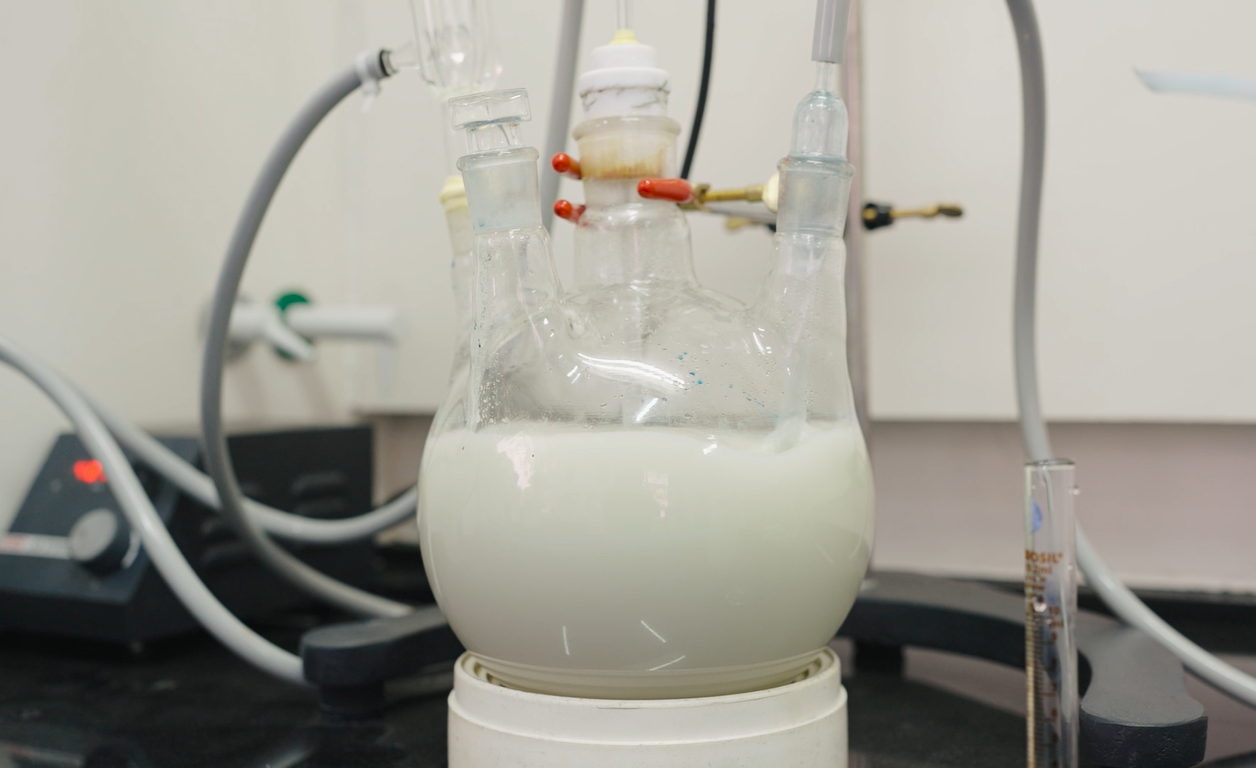
Macsen has developed a novel single-step, single-vessel synthesis process that addresses the key challenges that have earlier limited Prussian White to laboratory-scale production, namely, moisture sensitivity, oxygen exposure, and scalability constraints.

Working Mechanism of Prussian White as Battery Cathode
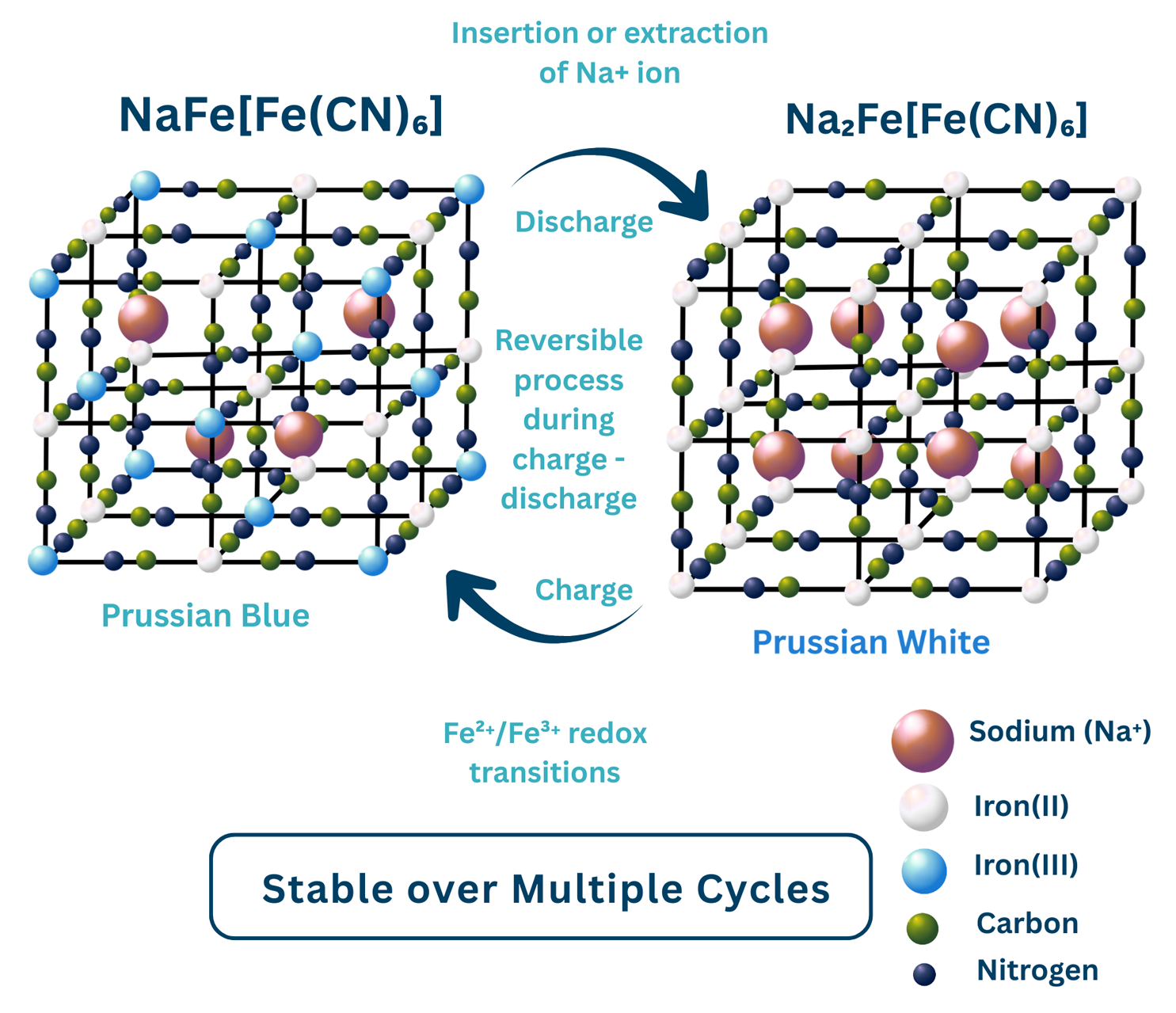
Prussian White is a sodium-rich analogue of Prussian Blue Analogues (PBAs) with a three-dimensional cubic open-framework structure formed by metal centers connected through cyanide (–C≡N–) bridges, acting as a 3D ion sponge and making it highly suitable for sodium storage.
Prussian white framework contains Fe²⁺ centers in both coordination environments, forming a stable hexacyanoferrate octahedral network. During electrochemical cycling, a reversible Fe²⁺/Fe³⁺ redox transition occurs depending on the state of charge.
Sodium ions reversibly insert into and extract from the interstitial sites of this framework during battery operation. During charging, electrons are removed from the cathode, and Na⁺ ions migrate from the Prussian White structure through the electrolyte toward the anode (typically hard carbon) to maintain charge neutrality. This process is accompanied by oxidation of Fe²⁺ to Fe³⁺, shifting the structure towards the Prussian Blue state.
During discharging, Na⁺ ions return from the anode into the cathode framework while electrons flow through the external circuit back to the cathode. Fe³⁺ is reduced back to Fe²⁺, restoring the Prussian White state. Because iron readily switches between these two oxidation states, the Fe²⁺/Fe³⁺ redox process repeats reliably over thousands of cycles, enabling the material to store and release energy efficiently.
Applications of Prussian White as Cathode Material
Prussian White is a promising cathode material widely used in advanced sodium-ion battery technologies and large-scale energy storage systems due to its high specific capacity and excellent cyclability. It is emerging as a cost-effective alternative to lithium iron phosphate (LFP) batteries for stationary energy storage and selected mobility applications due to its low cost and non-toxic chemical composition, making it a sustainable solution in battery technology. Its elemental composition of Na, Fe, C, N, Mn, and Ni is earth-abundant and free from geological constraints, which also supports its availability for commercial and industrial applications.
1

Grid-Scale Energy Storage

Prussian White-based sodium-ion batteries are well-suited for stationary energy storage applications and Battery Energy Storage Systems (BESS). Its stable electrochemical performance and enhanced safety characteristics make Prussian White highly suitable for large-scale energy infrastructure grid balancing systems.
2

Commercial & Household Power Backup Systems

Due to its high ionic conductivity and rapid sodium-ion diffusion characteristics, Prussian White-based batteries can support fast charge-discharge operation, high-power stationary energy storage applications, and uninterruptible power supply (UPS) systems. Its applications also include household inverter systems and residential solar storage, where reliability, safer operation, and cost efficiency are important.
3

Short-range Electric Mobility

Prussian White batteries are suitable for electric scooters, e-bikes, golf carts, utility vehicles, automated guided vehicles (AGVs), and other low-speed electric mobility applications where reliability, safety, and cost efficiency are important considerations.
4

Solar and Renewable Energy Storage

Prussian White is gaining significant attention as a cathode material in sodium-ion batteries for storing energy generated from solar and wind sources in both grid-connected and off-grid systems due to its low cost, sustainability, safety, and favorable electrochemical performance.
Request technical specifications, sample quantities, and application support from our R&D Team.

Frequently Asked Questions (FAQs)

What is the Formula of Prussian white?

Prussian white is a sodium iron hexacyanoferrate compound, having the chemical formula Na2Fe[Fe(CN)6].

What is the difference between Prussian Blue and Prussian white?

Prussian Blue (also known as Berlin blue, Brandenburg blue, Parisian, and Paris blue) is an inorganic complex salt, produced by oxidation of ferrous ferrocyanide salts, while Prussian White (PW) is the fully reduced, sodium-rich analogue of Prussian Blue, widely used in sodium-ion batteries (SIBs) as a cathode material.

What is the color of Prussian white?

Prussian White is generally off-white to pale blue in color. Its appearance mainly depends on its chemical composition, particularly whether it is iron-based or manganese-based, as well as its sodium content and synthesis conditions.

What is the specific capacity of Prussian white?

Prussian white is a promising cathode material for sodium-ion battery, and it has a specific theoretical capacity of about 160–170 mAh/g.


    This will close in 0 seconds